Most guides to rare sovereigns look backwards. They tell you about Victorian shield backs and the 1937 Edward VIII. Those coins are wonderful. They are also out of reach for almost everyone.
The modern sovereign tells a different story, and a more useful one. Since 1980 the Royal Mint has issued proof sovereigns in numbers that would surprise many collectors. Several years produced fewer than 5,000 coins. One produced 3,263.
This guide ranks them. It covers the full sovereign from 1980 to the present, explains why published figures often disagree, and shows why the mintage on the certificate is only half the picture.
The first thing to understand: this is a proof story
Bullion sovereigns are struck in enormous numbers. Hundreds of thousands in a typical year. Even the leanest modern bullion year, 2001, saw 49,462 coins.
Proof sovereigns are different. They are struck from polished dies onto specially prepared blanks, issued in presentation cases with numbered certificates, and limited by design. So when a collector talks about a low mintage sovereign, they almost always mean a proof. A surprising number of published mintage tables blur that distinction.
Mintage, issue limit and Limited Edition Presentation
Three terms get used interchangeably. They are not the same thing. Limited Edition Presentation, or LEP, is the maximum number the Royal Mint authorises, and it appears on the certificate. Issue limit is another term for the same idea. Mintage should mean the number actually struck and sold.
The gap between them can be large. The 2014 proof sovereign carried an issue limit of 7,500. Only 3,263 were struck individually. The Royal Mint chose not to supply dealers with that coin, so sales came in well below the limit. When you see a figure quoted, ask which of the three it is.
Why the same coin has two different mintages
There is a second reason figures disagree. Many proof sovereigns were sold both individually and inside multi coin sets. The 1989 Tudor Rose sovereign is the clearest example. 10,535 were issued individually in their own presentation case. Including coins supplied within sets, the total reaches 23,471. Neither figure is wrong. They measure different things.
The lowest mintage modern proof sovereigns, ranked
Figures are for individually issued proof full sovereigns, sourced to Spink Coins of England and the Royal Mint.
| Rank | Year and coin | Mintage |
|---|---|---|
| 1 | 2014 St George | 3,263 |
| 2 | 1993 St George | 4,349 |
| 3 | 2015 Rank Broadley portrait | 4,546 |
| 4 | 1991 St George | 4,713 |
| 5 | 1992 St George | 4,722 |
| 6 | 1990 St George | 4,767 |
| 7 | 1994 St George | 4,998 |
| 8 | 1986 St George | 5,079 |
| 9 | 2012 Diamond Jubilee | 5,501 |
| 10 | 2010 St George | 6,809 |
| 11 | 2011 St George | 7,181 |
| 12 | 2009 St George | 7,354 |
| 13 | 2015 Jody Clark portrait | 7,494 |
| 14 | 2016 James Butler portrait | 7,495 |
| 15 | 1995, 1996 and 1997 | 7,500 each |
A note on 1993. Chards records 4,349. One published table gives 6,090. We quote the lower figure because it is the better supported of the two.
2014: the lowest of the modern era
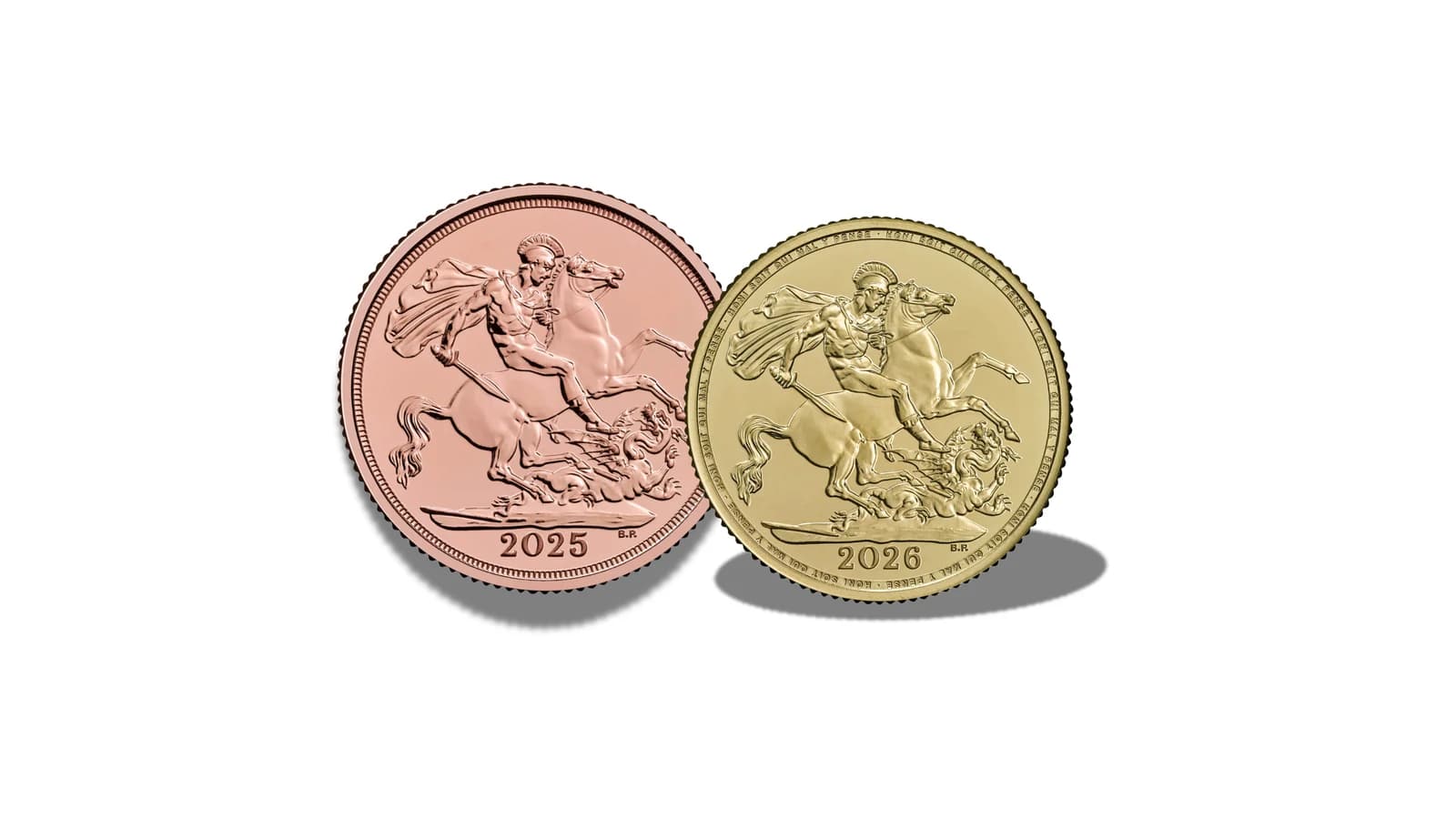
3,263 individually issued proof sovereigns against an issue limit more than double that. There is nothing unusual about the design. It is the standard Pistrucci reverse with the fourth portrait. Its scarcity is purely a matter of how few were made.
1989: the Tudor Rose
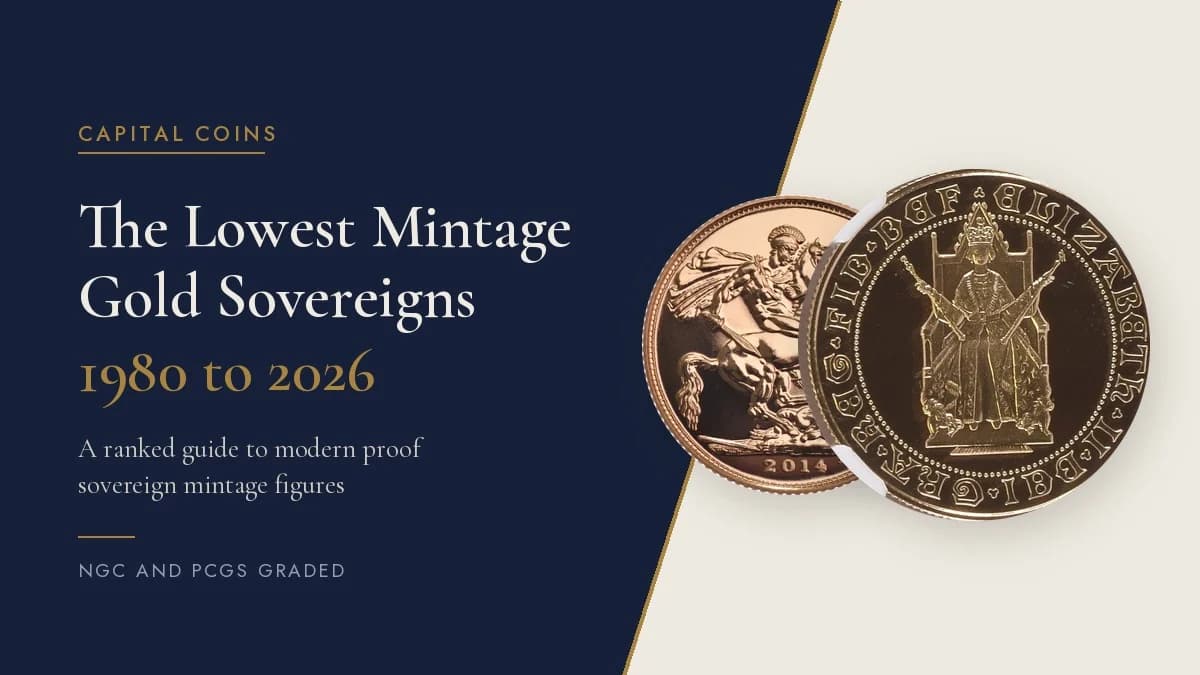
The most recognisable modern sovereign. Struck for the 500th anniversary of the first gold sovereign of Henry VII, it abandons St George entirely. The reverse shows the Royal Arms on a double Tudor rose and the obverse shows the Queen enthroned, both designed by Bernard Sindall. It is the only modern sovereign to carry the word sovereign in its legend. The design was used for a single year and never repeated.
1990 to 1994: the Maklouf years
Five consecutive years between 4,349 and 4,998 coins. There is a structural reason for this. Between 1983 and 1997 the Royal Mint struck no bullion sovereigns at all. The proof was the only sovereign available, and demand in those years was modest. These are quietly among the scarcest sovereigns of the past half century.
2016: the James Butler portrait
7,495 individually issued, 9,675 in total. The significance is the obverse. James Butler's portrait of the Queen, created for her ninetieth birthday, appeared on the proof sovereign for one year only. The bullion coins that year used the Jody Clark portrait instead.
2023: the Coronation piedfort
950 authorised, 960 struck. The lowest figure of any piedfort sovereign issued to date. A piedfort is struck to double the normal thickness and weight, so it sits in its own category rather than competing directly with the full sovereigns above.
Why mintage alone will mislead you
A mintage figure tells you how many coins left the Royal Mint. It tells you nothing about how many survive in perfect condition today.
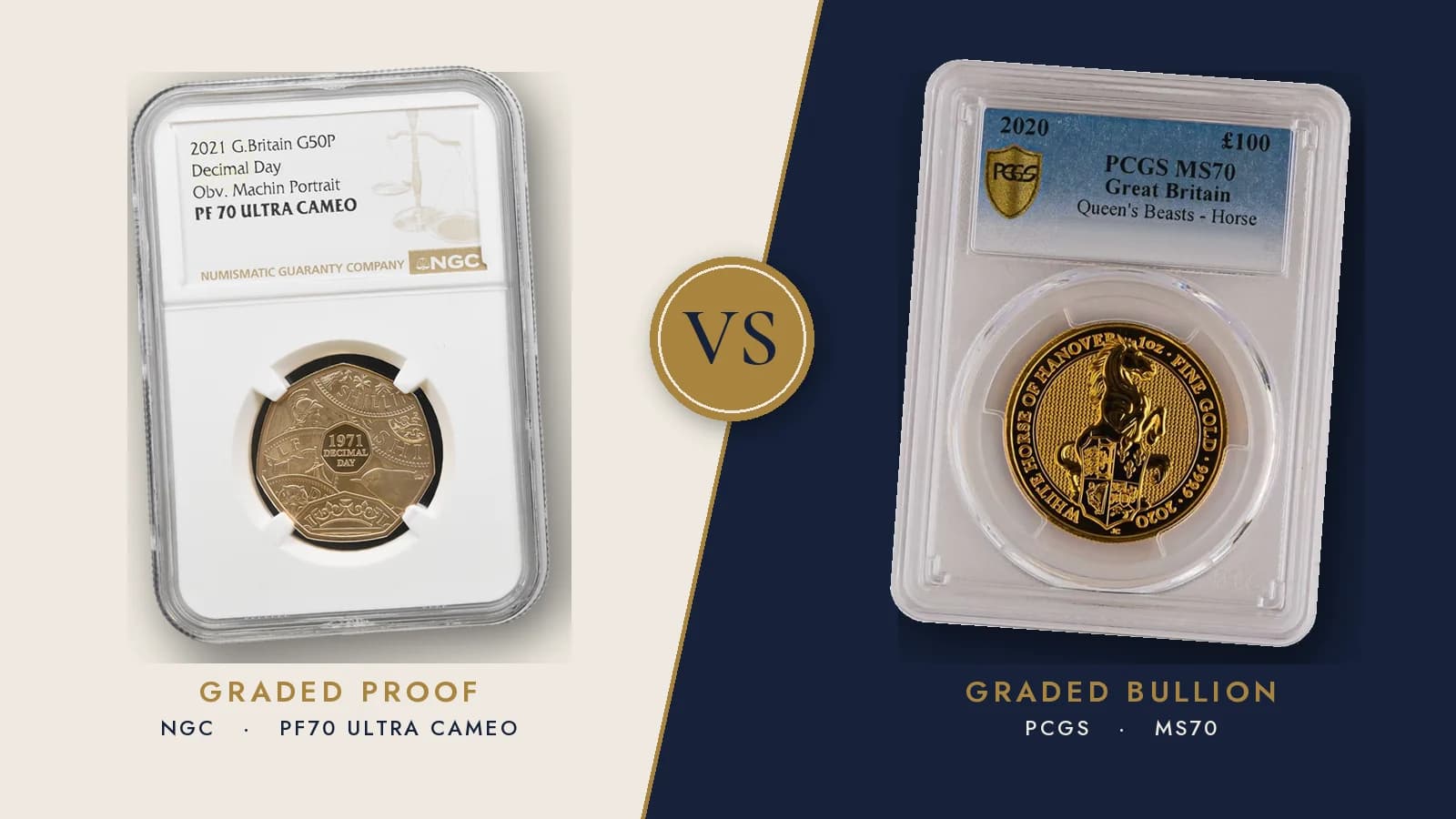
Proof coins are handled. They are opened, examined, sometimes cleaned. Spots develop inside cases over decades. By the time a coin is submitted for independent grading, only a portion achieve the top grade of PF70, awarded when a coin shows no imperfections at 5x magnification.
Consider two coins. The 1989 Tudor Rose has a total mintage of 23,471, yet of the examples submitted to NGC only around 157 have achieved PF70 Ultra Cameo out of roughly 508 graded. The 2017 200th anniversary sovereign has a comparable mintage of around 12,681, yet more than 700 examples have achieved PF70. Same broad mintage, very different scarcity at the top of the grading scale.
For anyone building a collection of graded coins, the population report published by NGC and PCGS is the figure that matters most. It also changes, because both services continue to grade coins submitted to them. We check current populations before describing any coin as scarce in its grade.
The years with no bullion sovereign
Between 1983 and 1997 no bullion sovereign was struck. For those fifteen years the proof is the only sovereign bearing the date, which is why the figures in that stretch are so consistently low. Bullion production resumed in 1998. Separately, the Royal Mint has not published a bullion sovereign mintage since 2016, so any bullion figure quoted for a later year is an issue limit or an estimate rather than a confirmed number.
How to read a mintage figure before you buy
Establish whether the figure is an issue limit or the number actually struck. Check whether it counts individual coins only, or includes coins supplied in sets. Confirm which finish it refers to, because proof and bullion figures for the same year are not comparable. For a graded coin, look up the current population at that grade on the NGC or PCGS website using the certification number. Finally, check the source. Spink Coins of England and Marsh's The Gold Sovereign are the standard references.
Frequently asked questions
What is the lowest mintage modern gold sovereign? The 2014 proof sovereign, with 3,263 individually issued coins against an issue limit of 7,500. Including coins supplied in sets, the figure is 4,613.
How many 1989 Tudor Rose sovereigns were made? 10,535 were issued individually in their own presentation case. Including coins supplied within multi coin sets, the total is 23,471.
Is a 2014 sovereign rare? The 2014 proof sovereign has the lowest individual mintage of any modern proof sovereign. The 2014 bullion sovereign is a different coin and was struck in far larger numbers.
What does mintage mean on a coin? Mintage is the number of coins struck. On modern Royal Mint certificates you will more often see a Limited Edition Presentation, which is the maximum authorised rather than the number actually produced.
Which years had no gold sovereign? Every year from 1980 onwards has a sovereign of some kind. However no bullion sovereign was struck between 1983 and 1997, so for those years only proof coins exist.
Are low mintage sovereigns harder to find in PF70? Not necessarily. Some coins with modest mintages have large numbers of PF70 examples, while others with higher mintages have very few. The population report is a better guide than the mintage alone.
Our graded sovereigns
Capital Coins holds a selection of proof sovereigns certified by NGC and PCGS, including key dates and one year designs. Every coin carries its own certification number, which you can verify on the grading service's public register.
Sovereigns are collectable items. Mintage figures are drawn from Spink Coins of England, Marsh's The Gold Sovereign and Royal Mint publications, and are sometimes reported inconsistently between sources. Population figures change as further coins are graded. Last updated September 2026.
Common questions
- What is the lowest mintage modern gold sovereign?
- The 2014 proof sovereign, with 3,263 individually issued coins against an issue limit of 7,500. Including coins supplied in sets, the figure is 4,613.
- How many 1989 Tudor Rose sovereigns were made?
- 10,535 were issued individually in their own presentation case. Including coins supplied within multi coin sets, the total is 23,471.
- Is a 2014 sovereign rare?
- The 2014 proof sovereign has the lowest individual mintage of any modern proof sovereign. The 2014 bullion sovereign is a different coin and was struck in far larger numbers.
- What does mintage mean on a coin?
- Mintage is the number of coins struck. On modern Royal Mint certificates you will more often see a Limited Edition Presentation, which is the maximum authorised rather than the number actually produced.
- Which years had no gold sovereign?
- Every year from 1980 onwards has a sovereign of some kind. However no bullion sovereign was struck between 1983 and 1997, so for those years only proof coins exist.
- Are low mintage sovereigns harder to find in PF70?
- Not necessarily. Some coins with modest mintages have large numbers of PF70 examples, while others with higher mintages have very few. The population report is a better guide than the mintage alone.
Capital Coins is a trading style of CC Britain Limited. All coins are offered as collectible items and not as investments. UK legal tender coins are currently exempt from Capital Gains Tax for UK residents and investment gold is exempt from VAT; tax treatment depends on individual circumstances and may change, and independent professional advice should be sought. Grading details are stated per individual coin and census figures reflect the certification service census at the time of writing. Prices are subject to the coins remaining unsold and reflect prevailing market conditions. Past auction results do not guarantee future value.